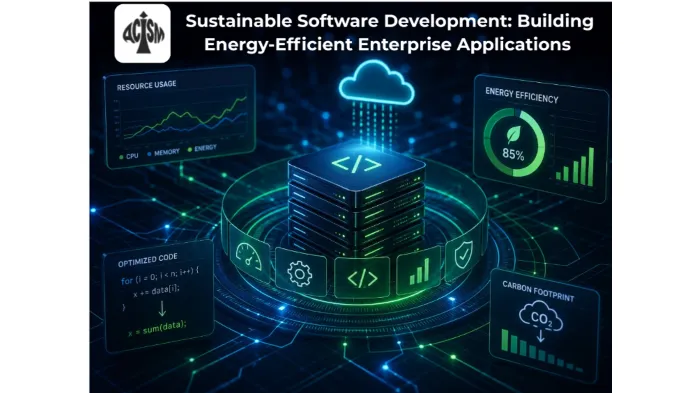
Visual representation of sustainable software development using optimized code, efficient resource utilization, and energy-efficient enterprise applications to reduce environmental impact.
Visual representation of sustainable software development using optimized code, efficient resource utilization, and energy-efficient enterprise applications to reduce environmental impact.
Table of Contents
As organizations accelerate their digital transformation initiatives, software has become a critical driver of business operations. While functionality and performance often receive the most attention during development, an equally important consideration is how efficiently software consumes resources throughout its lifecycle. This is where Sustainable Software Development plays a vital role.
When discussing sustainability, most people think of reducing carbon emissions and improving energy efficiency. These principles are increasingly relevant in software engineering because every application consumes computing resources. Servers process requests, store data, and execute business logic around the clock. The efficiency of a software system directly influences how much energy those servers consume and, ultimately, its environmental impact.
Software systems are growing larger and more complex every year. As organizations expand their digital capabilities, infrastructure requirements often increase as well. Applications that consume excessive processing power require more server resources, resulting in higher operational costs and greater energy consumption.
Sustainable Software Development encourages organizations to consider efficiency from the beginning. By selecting the right technologies, optimizing code, and reducing unnecessary processing, businesses can lower infrastructure expenses while contributing to broader sustainability goals.
One of the most overlooked aspects of software sustainability is the choice of programming language. Different programming languages require varying levels of processing power to perform similar tasks. Greater processing requirements often lead to higher energy consumption.
Research has consistently shown that compiled languages such as C and C++ are among the most energy-efficient options available. Java also performs exceptionally well, offering a strong balance between performance, scalability, and efficiency.
Since software energy consumption contributes directly to its overall carbon footprint, selecting efficient programming languages can help organizations reduce both infrastructure costs and environmental impact.
This is one reason Acism primarily uses Java as a foundation for enterprise applications. Java offers an effective combination of scalability, reliability, performance, and efficiency. From an environmental perspective, choosing efficient technologies supports the goals of Sustainable Software Development by reducing resource consumption throughout the software lifecycle.
| Factor | Impact on Energy Consumption | Sustainability Benefit |
|---|---|---|
| Efficient Programming Languages | Requires less processing power | Reduces software carbon footprint |
| Optimized Code | Eliminates unnecessary computation | Lowers energy usage |
| Modern Frameworks | Improves resource utilization | Enhances operational efficiency |
| Removal of Dead Code | Reduces system overhead | Improves application performance |
| Regular Modernization | Enables adoption of efficient technologies | Supports long-term sustainability |
The efficiency of an application is not determined solely by the programming language. Code quality also plays a significant role.
Applications often become patchy as development teams change over time. While functionality may continue to work, chunks of legacy code that few developers fully understand tend to accumulate. This code can become a source of inefficiencies, including redundant processing, unnecessary logic, and increased resource consumption.
Thus, over time, applications often accumulate inefficient loops, redundant processing logic, and unused code. As development teams change, portions of legacy code may remain untouched because developers are reluctant to modify components they do not fully understand.
This accumulation of dead code and inefficient logic can negatively impact application performance and increase resource consumption. As a result, organizations may spend more on infrastructure while experiencing reduced system efficiency.
A component-based development approach can help address these challenges.
Handwritten code remains within isolated components, making it easier to understand, optimize, and maintain. The code that orchestrates interactions among components is automatically generated, reducing the likelihood of inefficient integration logic accumulating over time.
By organizing functionality into smaller, manageable components, development teams can identify inefficiencies more easily and implement targeted improvements without disrupting the entire application.
The X-Flowcharts used within the Xsemble ecosystem provide visual representations of application behavior, making it easier to examine workflows, identify inefficiencies, and implement optimizations. As a result, Acism's approach helps organizations reduce resource consumption while supporting long-term software sustainability.
Legacy systems often struggle to benefit from advances in programming languages, frameworks, and optimization techniques. Older applications may continue running on outdated technologies that consume more resources than modern alternatives.
Modernization enables organizations to adopt improved language features, efficient libraries, and updated architectural approaches that reduce resource consumption.
In contrast, Xsemble-powered applications are easier to modernize because functionality is organized into isolated components. This allows development teams to upgrade specific areas of the application without disrupting the entire system.
In addition, X-Flowcharts provide clear visibility into application behavior, helping teams identify optimization opportunities and support continuous modernization initiatives. As a result, organizations can adopt newer technologies more efficiently while maintaining long-term software sustainability.
As environmental responsibility becomes a priority across industries, software efficiency is gaining greater attention. Sustainable Software Development encourages organizations to look beyond immediate functionality and consider the long-term impact of their applications.
By choosing efficient technologies, optimizing code structures, and embracing modernization strategies, businesses can reduce operational costs while lowering the carbon footprint of their software systems.
Organizations that prioritize sustainability in software development are better positioned to create applications that remain efficient, adaptable, and environmentally responsible for years to come.
Acism supports Sustainable Software Development through a combination of energy-efficient technologies, component-based architecture, and modernization-focused practices. By leveraging Java, Xsemble, and X-Flowcharts, Acism helps organizations improve software efficiency, reduce resource consumption, and simplify long-term optimization efforts.
This approach enables businesses to build software systems that remain efficient, scalable, and environmentally responsible throughout their lifecycle.
Sustainable Software Development extends beyond delivering functional applications. It involves creating software that uses resources efficiently throughout its lifecycle while minimizing environmental impact.
Through thoughtful technology choices, efficient coding practices, and continuous modernization, organizations can reduce software carbon footprints and improve long-term operational efficiency. As sustainability continues to influence business decisions worldwide, energy-efficient software will become an increasingly important component of successful digital transformation strategies.
1. What is Sustainable Software Development?
Sustainable Software Development focuses on creating software that remains efficient, maintainable, and resource-conscious throughout its lifecycle.
2. How does software contribute to carbon emissions?
Software consumes computing resources, which require electricity. Higher energy consumption can increase the carbon footprint of applications and infrastructure.
3. Why is Java considered an efficient programming language?
Java offers a strong balance of performance, scalability, and resource efficiency, making it suitable for enterprise applications.
4. How does code quality affect sustainability?
Inefficient code, dead code, and unnecessary processing increase resource consumption and operational costs. Good code which does not suffer from these issues is therefore more sustainable.
5. Why is modernization important for sustainable software?
Modernization helps organizations adopt more efficient technologies and optimization techniques, reducing long-term resource usage.
This code is WordPress HTML block ready and includes a fully clickable Table of Contents that jumps to each corresponding section. In/aL6.36MLD68.2MIn/awhoissourceRank26PIN91.9KSummary reportDiagnosisDensity06n/a