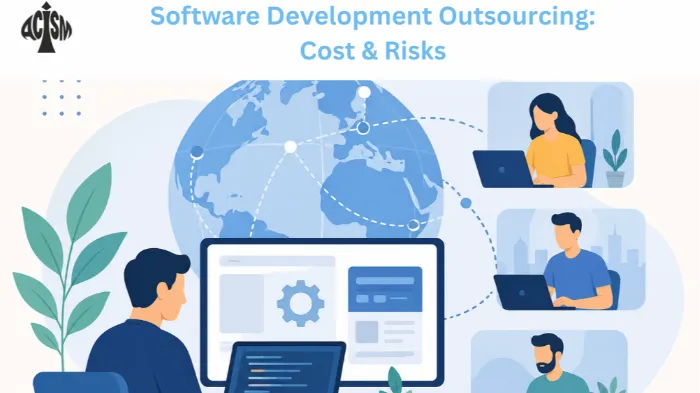
A visual representation of software outsourcing highlighting global collaboration, structured development workflows, and scalable technology solutions.
A visual representation of software outsourcing highlighting global collaboration, structured development workflows, and scalable technology solutions.
Table of Contents
Outsourcing software development isn't a new idea, but the way businesses approach it has changed considerably. The early promise of lower cost, faster delivery and access to global talent was real. So were the failures. Projects that stalled, codebases that nobody could maintain, and engagements that ended with disputes instead of software. Software development outsourcing services have matured, but the gap between a well-run engagement and a poorly run one is still significant.
This guide covers what software development outsourcing services actually involve, what the costs look like in real terms, where the hidden risks sit, and what to look for in a partner before signing anything.
Software development outsourcing services involve contracting an external team offshore, nearshore, or onshore to design, build, or maintain software rather than handling it with in-house staff. The scope can range from a single development team augmenting existing engineering capacity to a full-cycle engagement where the external partner handles everything from requirement documentation through deployment.
The model appears in several forms. Offshore software development outsourcing means working with a team in a different country, typically to access lower development costs or specific technical skills. Nearshore arrangements involve teams in adjacent time zones. Onshore outsourcing uses external firms in the same country. Each model comes with trade-offs in cost, communication efficiency, availability, and team experience/maturity.
What software development outsourcing services don't change is the underlying requirement for process discipline. A well-structured onshore engagement can still fail on requirements documentation. An offshore team with a rigorous methodology can deliver reliably. Geography is one variable. Process is the more important one.
Software development cost estimation for outsourced engagements is where most businesses make their first mistake. The headline rate hourly or per-sprint cost is the easy part. The hidden cost is what happens when that rate gets applied to an engagement that wasn't scoped properly.
When requirements are vague, scope expands. When architecture isn't documented, rework accumulates. When knowledge lives in the outsourced team's heads and isn't captured in documentation, every question costs time and every team change costs earlier.
A realistic cost picture for software development outsourcing services should account for requirement documentation, architecture design, development across iterations, QA, and handover documentation thorough enough for any future team to maintain the codebase. Projects that include a software development proof of concept stage before full commitment also tend to control costs better. Developing a PoC (Proof of Concept) surfaces technical assumptions that would otherwise appear mid-build, when they're expensive to fix.
Software development outsourcing services give organizations access to technical depth they can't justify building in-house. For a business building fintech compliance software, a healthcare application, or a CRM software development project with domain-specific logic, the specialized knowledge may simply not exist on a typical internal engineering team. Outsourcing to a firm that has built these systems before is faster than developing the expertise from scratch.
Speed to market is a real benefit when the engagement is structured well. A development partner running modular iterations closer to MVP agile development than a sequential waterfall approach lets clients test and validate each stage before committing to the next. This is particularly valuable for businesses entering a new market or building a platform where the full scope isn't clear from the start.
Software development outsourcing services also let organizations scale engineering capacity without the overhead of permanent headcount. For a SaaS software development company building toward a product launch, or an enterprise team modernizing legacy infrastructure through software modernization services, outsourcing provides the capacity needed without the hiring cycle and without the long-term fixed cost.
The most common hidden risk in software development outsourcing services is knowledge concentration. When the architecture of a system lives only in the outsourced team's working memory – not in visual documentation, not in written specifications – the project is risked every time someone on that team leaves. Re-onboarding new developers takes time and money that wasn't in the original estimate. If the engagement ends, the client may be left with a codebase that nobody else can confidently maintain or extend.
Requirement ambiguity is the second risk. Software development outsourcing services engagements that begin without detailed, signed-off requirements tend to generate disputes. What the client expected and what the outsourced team delivered diverges, and there's no reference document to settle the disagreement. Most outsourced project failures trace back to this stage not to technical shortfalls, but to the absence of written alignment at the start.
Technology choices made by an outsourced team also carry hidden risk. Software built on niche frameworks or internally developed tooling can become hostage to the original developers. Software development outsourcing services built on mature, widely adopted software development technologies remain maintainable when the team changes which it always does eventually.
The first thing to verify is requirement documentation practice. Does the firm insist on written, stakeholder-approved requirements before any design begins? Software development outsourcing services engagements that skip this step tend to create scope disputes that are expensive to resolve and damaging to the working relationship.
Ask to see design artifacts from a previous engagement. Beyond the requirements, can business stakeholders understand and validate the design? This matters equally for custom enterprise software development, hospital application builds, and CRM software development. Architecture that only the development team can read is architecture that only the development team can maintain.
The development methodology matters especially with AI-accelerated workflows. SDLC models in software engineering range from the software development life cycle waterfall model which is sequential and difficult to adjust once started to iterative approaches that let clients validate deliverables as they're completed. For most software development outsourcing services engagements, a modular and iterative model manages risk better than a single long delivery cycle.
Ask specifically how the firm handles post-delivery maintainability. The best software development outsourcing services providers build documentation thorough enough that any competent developer – not just the original team – can maintain and extend the codebase independently. This is the criterion that separates engagements that compound in value from those that create long-term dependency on the original vendor.
Acism has been delivering software development outsourcing services out of Pune since 2001, with clients across fintech, manufacturing, healthcare, and B2B SaaS. The methodology was built to address the core failure mode of outsourced development: too much opacity Requirements in emails. Architecture in heads. Knowledge that walks out the door when a developer leaves.
The X-SDLC model keeps the internals of every engagement visible throughout. Components, data flow, control logic, and integration points are mapped in a format that domain experts can review and validate at each stage – not just at delivery but even before the coding begins. This structure supports modular, iterative builds. Clients can develop an initial feature set, pause the engagement, and restart later without a heavy re-orientation cost, because the software design was documented, not assumed.
For teams evaluating software consulting firms alongside outsourcing options, Acism also operates as a consulting partner scoping requirements for new builds, reviewing existing architectures, and stepping in to recover software development outsourcing services engagements that stalled under a previous vendor.
Software development outsourcing services work when the process is tight: requirements documented, architecture visible, technology choices made for long-term maintainability, and deliverables validated at each stage. They fail when those conditions aren't met, regardless of where the development team is located.
If you're building something your existing team doesn't have the capacity or the depth to build in-house, outsourcing is a practical answer. The question is whether the firm you choose will deliver software you can actually own and maintain when the engagement ends.
To discuss a specific project, explore Acism's Application Development Services or contact the team directly at contact@acism.com.
1. What are software development outsourcing services?
Software development outsourcing services involve contracting an external firm offshore, nearshore, or onshore to design, build, test, and maintain software rather than handling it with in-house engineers. The scope can cover a single module, a development team, or the full cycle from requirements through deployment and handover.
2. What is the real cost of software development outsourcing services?
Software development cost estimation for outsourced projects needs to account for more than the hourly or sprint rate. Hidden costs accumulate when requirements are vague, architecture isn't documented, and handover is incomplete generating rework, scope disputes, and re-onboarding costs that don't appear in the original estimate.
3. What are the biggest risks in software development outsourcing services?
The two most common risks are knowledge concentration where architecture lives in the outsourced team's heads rather than in documentation and requirement ambiguity, where the absence of signed-off requirements creates disputes when the delivered software doesn't match what the client expected.
4. How do I choose the right software development outsourcing services provider?
Look for firms that insist on detailed requirement documentation before design begins, produce architecture that business stakeholders can validate, use iterative development models rather than a single long delivery cycle, and build documentation thorough enough for any future team to maintain the codebase without returning to the original vendor.
5. Can Acism take over a software development outsourcing engagement that has already stalled?
Yes. Acism handles recoveries software development outsourcing services engagements that have stalled, exceeded budget, or been poorly managed by a previous vendor. The X-SDLC model makes it possible to step into an existing project, make the architecture visible, and determine what's actually needed to complete the build.