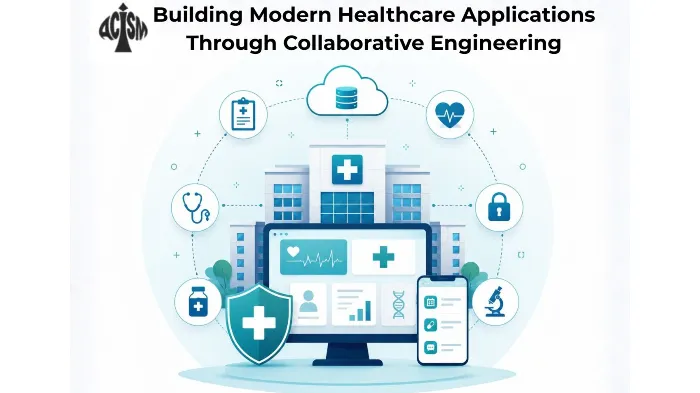
Modern healthcare software development powered by collaborative engineering, secure digital infrastructure, cloud connectivity, and scalable healthcare technology solutions.
Modern healthcare software development powered by collaborative engineering, secure digital infrastructure, cloud connectivity, and scalable healthcare technology solutions.
The healthcare industry is evolving rapidly, with technology becoming an integral part of delivering efficient, patient-centric care. Hospitals, specialty clinics, diagnostic laboratories, and healthcare providers are increasingly investing in digital solutions to improve patient outcomes, streamline operations, and enhance clinical decision-making. From appointment scheduling and Electronic Health Records (EHR) to laboratory management, telemedicine, and patient engagement platforms, software now supports almost every stage of the healthcare journey.
As organizations accelerate their digital transformation, many begin evaluating healthcare software development services to modernize their operations. While healthcare domain knowledge is important, building successful healthcare applications requires more than understanding medical terminology or hospital processes. It requires a structured engineering approach that can accurately translate healthcare expertise into reliable, scalable, and maintainable software.
This is where Acism offers a different perspective.
Acism is not a healthcare-exclusive software company. Instead, it is an engineering-driven technology company that collaborates closely with healthcare professionals to deliver healthcare software development services that align with real clinical workflows. Rather than relying solely on documentation, Acism combines domain expertise with its X-SDLC methodology and Xsemble visual engineering technology to ensure that healthcare applications are built with clarity, transparency, and long-term maintainability in mind.
By allowing healthcare experts to focus on clinical and operational workflows while software engineers concentrate on architecture, security, scalability, and application design, Acism creates a collaborative development process that reduces misunderstandings and delivers software that continues to evolve with the organization.
When organizations evaluate healthcare software development services, they often assume that selecting a company with healthcare experience is enough to guarantee project success. While industry knowledge certainly adds value, it is only one part of developing effective healthcare software.
Every healthcare organization operates differently.
A multispecialty hospital follows different workflows than a diagnostic laboratory. A rehabilitation center manages patient care differently from a cancer treatment facility. Even hospitals using the same Hospital Information System often customize patient registration, billing, laboratory processes, pharmacy management, and administrative approvals to match their internal operations.
This means that no software provider can completely understand an organization's workflows without collaborating with the people who perform those processes every day.
Each group contributes valuable expertise, and successful healthcare software development services bring these perspectives together throughout the project lifecycle.
Traditional software development often depends heavily on requirement documents and technical specifications. As projects progress, business requirements change, documents become outdated, and different stakeholders begin interpreting the same process differently. These communication gaps frequently lead to project delays, repeated development effort, and software that no longer reflects the organization's actual needs.
Instead of depending solely on documentation, Acism follows an engineering-first methodology that promotes continuous collaboration between healthcare professionals and software engineers. This structured approach helps validate workflows early, improves communication, and ensures the application accurately represents real healthcare operations before development progresses too far.
One of the biggest challenges in software projects is transforming business requirements into applications without losing important operational knowledge along the way.
Acism addresses this challenge by treating software development as an engineering discipline rather than simply a coding exercise.
Every project begins with understanding how healthcare organizations actually function. Clinical workflows, patient journeys, administrative processes, and operational requirements are reviewed collaboratively before development starts. This ensures that everyone involved shares the same understanding of the application's objectives.
Using its proprietary X-SDLC (Extended Software Development Life Cycle) methodology, Acism delivers healthcare software development services through a structured engineering process that emphasizes collaboration, validation, and transparency. Instead of relying exclusively on lengthy requirement documents, the methodology encourages continuous interaction between healthcare professionals and software engineers throughout the software lifecycle.
This collaborative approach allows healthcare experts to validate business processes while developers focus on designing secure, scalable, and maintainable applications. Because requirements are continuously reviewed and refined, misunderstandings are identified early, reducing project risks and minimizing unnecessary rework.
For organizations investing in healthcare software development services, this engineering-first methodology provides greater confidence that software is being built around real operational needs instead of assumptions made during initial requirement discussions.
Healthcare organizations continue evolving long after a software application has been deployed.
Applications that are designed only to meet today's requirements often become increasingly difficult to modify as organizations evolve.
Many software projects initially deliver the required functionality, but future enhancements become expensive because long-term maintainability was not considered during development. Organizations become dependent on a few developers who understand the application, documentation gradually loses relevance, and even small changes require significant effort.
The underlying problem is rarely the technology itself.
More often, software has been developed with a primary focus on coding rather than engineering.
Engineering considers the complete lifecycle of an application. It focuses on creating software that remains transparent, maintainable, adaptable, and scalable as business requirements change.
This philosophy is central to Acism's healthcare software development services. By applying disciplined engineering practices from the beginning, Acism develops healthcare applications that continue supporting organizational growth while remaining easier to understand, maintain, and enhance over time.
Modern healthcare organizations require more than standalone software solutions. They need connected digital platforms that improve collaboration, simplify operations, and provide healthcare professionals with accurate information when they need it. This is why healthcare software development services have become a strategic investment rather than just a technology upgrade.
A well-designed healthcare application supports the complete patient journey. From online appointment booking and patient registration to consultations, laboratory testing, pharmacy management, billing, and discharge, every process should work together seamlessly. Connected applications eliminate duplicate data entry, reduce administrative effort, and improve communication across departments.
Comprehensive healthcare software development services also focus on interoperability. Modern applications should integrate with Electronic Health Records (EHR), laboratory systems, diagnostic equipment, pharmacies, insurance providers, and third-party healthcare platforms. These integrations allow healthcare organizations to build a unified digital ecosystem that supports both operational efficiency and better patient experiences.
As healthcare organizations continue expanding their services, applications should remain flexible enough to accommodate new departments, changing regulations, and evolving patient expectations. Choosing healthcare software development services built on strong engineering principles ensures that applications continue delivering value without requiring major redevelopment.
No two healthcare organizations operate in exactly the same way. Clinical workflows, approval processes, patient management models, and reporting requirements vary significantly from one organization to another.
While off-the-shelf software provides standard functionality, it often requires healthcare organizations to adjust their existing processes to match the software. This can reduce productivity, increase training requirements, and create operational inefficiencies.
Custom healthcare software development services take a different approach by designing applications around an organization's existing workflows. Doctors, nurses, administrators, and support staff can continue following familiar processes while benefiting from automation, improved collaboration, and centralized information.
Custom applications also provide long-term flexibility. As healthcare organizations introduce new services, expand their facilities, or adopt emerging technologies, the software can evolve alongside the business. This reduces future redevelopment costs and helps organizations continue their digital transformation with confidence.
Developing healthcare software is only the beginning of the journey. The real challenge is ensuring that applications remain understandable, maintainable, and adaptable throughout their lifecycle.
Healthcare organizations regularly update their processes to meet new clinical practices, regulatory requirements, and operational goals. Applications must support these changes without becoming increasingly difficult to maintain.
As part of its healthcare software development services, Acism uses Xsemble, a visual engineering technology that complements its X-SDLC methodology. Instead of relying entirely on traditional documentation, Xsemble helps preserve application knowledge in a structured and transparent manner, making it easier for development teams to understand how applications function even years after deployment.
This approach simplifies onboarding for new developers, accelerates future enhancements, and reduces the dependency on individual team members. More importantly, it enables healthcare organizations to continue improving their applications without compromising stability or increasing maintenance complexity.
Healthcare organizations need more than software developers. They need a technology partner capable of converting complex healthcare requirements into reliable and scalable applications.
Acism delivers healthcare software development services through an engineering-first approach that emphasizes collaboration, transparency, and long-term maintainability. Instead of relying solely on written requirements, the company works closely with healthcare professionals throughout the development lifecycle to validate workflows and ensure that applications accurately represent real operational processes.
Its X-SDLC methodology provides a structured framework for software engineering, while Xsemble supports long-term application evolution by improving visibility into application behavior. Together, they help organizations reduce project risks, simplify future enhancements, and develop software that continues supporting business growth.
Rather than positioning itself as a healthcare-specialist software vendor, Acism focuses on collaborative partnerships with healthcare experts and combining their domain knowledge with disciplined engineering practices. This enables the delivery of high-quality healthcare software development services that remain relevant as healthcare organizations continue evolving.
Technology has become an essential part of modern healthcare, supporting everything from patient engagement and clinical decision-making to hospital administration and operational efficiency. As healthcare organizations continue investing in digital transformation, selecting the right healthcare software development services becomes a critical business decision.
Success depends not only on healthcare knowledge but also on the ability to transform that expertise into software that is secure, scalable, maintainable, and aligned with real clinical workflows.
Acism brings together healthcare professionals and software engineers through an engineering-first development methodology that prioritizes collaboration, transparency, and long-term software sustainability. By combining X-SDLC with Xsemble, Acism delivers healthcare software development services that help healthcare organizations build applications capable of supporting both current operational needs and future growth.
Whether you are modernizing existing healthcare systems or developing a new digital platform, choosing engineering-driven healthcare software development services can help create solutions that continue delivering value well into the future.
Engage Acism to develop scalable, secure, and maintainable healthcare applications using an engineering-first approach.
📞 Phone: +91 9730668830
📧 Email: contact@acism.com
🌐 Website: https://acism.com
Healthcare software development services involve designing, developing, integrating, and maintaining digital applications for hospitals, clinics, diagnostic laboratories, and other healthcare organizations. These applications may include hospital management systems, Electronic Health Records (EHR) platforms, patient portals, telemedicine solutions, laboratory management systems, pharmacy software, and billing systems.
Custom healthcare software development services help organizations build applications that match their unique clinical workflows, operational processes, and future growth plans instead of adapting their business processes to standard software. This improves productivity, user adoption, and long-term flexibility.
Healthcare software development services can be used to build hospital management systems, Electronic Health Records (EHR), laboratory information systems, pharmacy management software, appointment scheduling platforms, telemedicine applications, patient engagement portals, healthcare analytics solutions, billing systems, and custom healthcare platforms.
Acism follows an engineering-first methodology using X-SDLC and Xsemble to improve collaboration between healthcare professionals and software engineers. This approach helps ensure applications accurately reflect healthcare workflows while remaining maintainable, scalable, secure, and adaptable for future business needs.
Healthcare organizations continuously evolve with changing regulations, technologies, and patient expectations. Maintainable software allows organizations to introduce new features, integrate additional systems, and adapt to changing business requirements without requiring major redevelopment or disrupting daily operations.
Healthcare software development services enable organizations to digitize clinical and administrative workflows, improve patient experiences, integrate healthcare systems, automate routine processes, enhance collaboration across departments, and build a connected digital ecosystem that supports long-term operational growth.