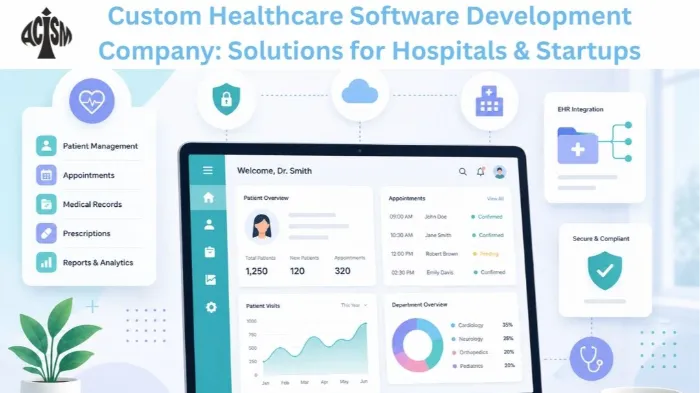
Custom healthcare software solutions for hospitals, clinics, and startups
Custom healthcare software solutions for hospitals, clinics, and startups
Healthcare software operates under constraints that most other software doesn't. Clinical data regulations, patient safety requirements, interoperability standards, and audit obligations aren't features to be added later. They are foundational requirements that determine whether a healthcare application can be used legally and safely. Working with a custom healthcare software development company rather than a general software firm is a practical response to this reality, not a premium choice reserved for large institutions.
This guide covers what a custom healthcare software development company actually builds, how to evaluate one properly, what the cost picture looks like, and how Acism fits in the healthcare software market – even for very niche areas.
A custom healthcare software development company designs and builds software specifically for healthcare environments: hospital management systems, electronic health record platforms, clinical decision support tools, telemedicine applications, patient portals, laboratory information systems, medical billing software, and compliance reporting platforms. The defining characteristic is that the software is built around how a specific healthcare organization actually operates, not how a generic vendor assumes it does.
This is different from deploying an off-the-shelf healthcare product. Commercial healthcare platforms are built for a broad market. A custom healthcare software development company builds for a specific institution, practice, or healthcare startup, with the exact data model, workflow logic, and integration requirements that organization needs. For hospitals with complex departmental structures, for healthcare startups building a novel clinical tool, or for medical software development companies building platforms for a defined patient population, the difference between generic and custom is operationally significant.
The regulatory environment in healthcare is not negotiable. A healthcare application handling patient data must meet specific standards depending on geography and system type. A hospital application managing clinical workflows must be built with the understanding that errors in software behavior carry direct patient safety implications. A custom healthcare software development company that has not built in this environment before will typically learn these requirements during the engagement, which means the client absorbs the cost of that learning curve. (We shall learn later how Acism changes the equations.)
The interoperability requirements in healthcare are also more demanding than most other sectors. Healthcare software frequently needs to exchange data with existing systems: laboratory platforms, imaging tools, pharmacy management infrastructure, and insurance processing systems. A custom healthcare software development company with genuine domain experience has navigated these integration challenges before. One without it tends to underestimate integration scope at the estimate software development cost stage, which produces budget and timeline overruns that appear well into the build.
For healthcare startups building an early product, working with a custom healthcare software development company that understands MVP agile development in a regulated environment is a distinct challenge from general MVP work. Compliance requirements don't relax because the product is early-stage, and the cost of retrofitting compliance architecture after the fact is consistently higher than building it in from the start.
The range of systems a custom healthcare software development company builds is broad. Hospital application platforms that manage admissions, patient records, discharge workflows, and departmental operations represent the most architecturally complex category. These systems integrate across clinical, administrative, and financial infrastructure and must maintain data integrity across all of them simultaneously.
Healthcare application development for patient-facing tools, including telemedicine platforms, patient portals, and remote monitoring systems, requires a different emphasis: interface design accessible to patients who are not technically sophisticated, reliability standards that reflect clinical stakes, and data security that meets applicable regulations. These requirements apply equally to a startup's first product and a large hospital's patient-facing system.
Medical software development companies also build tools for clinical research, laboratory management, pharmacy systems, and specialized practice management. For organizations that need a healthcare software development company with depth in a niche domain, such as oncology records, behavioral health, or home care coordination, domain knowledge matters as much as technical capability. A healthcare application built by a team unfamiliar with the clinical domain will miss workflow requirements that aren't obvious from a high-level specification.
For healthcare organizations that have outgrown their existing platforms, legacy software modernization services are often the practical starting point rather than a new build. Modernizing a hospital application built a decade ago requires preserving the clinical logic the organization depends on while replacing infrastructure that can no longer be maintained or connected to current systems.
The first filter is domain experience. Has the custom healthcare software development company built in regulated healthcare environments before? Ask specifically for examples of healthcare application builds that involved clinical data handling, compliance scope, and integration with third-party healthcare systems. General software experience adapted to healthcare is not the same as healthcare software experience, and the difference shows in how requirements are documented and how integration complexity is scoped.
Requirement documentation practice is the second filter. Healthcare software built on vague or incomplete requirements creates two problems simultaneously: the software may not match what clinical staff actually need, and ambiguity in documented requirements creates liability in regulated environments. A custom healthcare software development company that produces detailed, stakeholder-approved requirements before design begins reduces both risks at once.
The development methodology matters for regulated healthcare builds. SDLC models in software engineering range from the software development life cycle waterfall model, which delivers everything at the end of a long cycle, to iterative approaches that let clinical stakeholders validate behavior at each stage. For complex healthcare systems, iterative delivery is lower risk. It surfaces misalignments between clinical workflow and software behavior when corrections are still affordable, rather than at the end of a twelve-month build.
For organizations preparing a software development RFP for a healthcare project, a request for proposal for software development should specifically address compliance architecture, clinical data handling methodology, integration approach, and post-delivery documentation standards. The specificity and depth of responses from a custom healthcare software development company is a reliable indicator of whether they have navigated these requirements in practice.
Software development cost estimation for healthcare applications varies significantly with compliance scope and integration complexity. A patient portal with standard authentication and record access sits in a different cost category from a full hospital management system with multi-department workflows, real-time clinical decision support, and integration across a dozen existing platforms. A custom healthcare software development company that quotes a single project-wide figure without first auditing compliance requirements and integration scope is estimating from assumption rather than evidence.
A software development proof of concept is worth considering before full commitment on complex healthcare builds. A proof of concept validates that the integration architecture holds and that the data handling approach meets compliance requirements before the full build budget is committed. This stage is particularly valuable for healthcare startups where budgets are finite and mid-build rework is difficult to absorb.
Offshore software development outsourcing is a common delivery model for healthcare software, particularly for organizations that need specialist knowledge unavailable in their local market. The process discipline required in any high-stakes outsourced engagement applies here with additional rigor given the compliance and clinical safety context.
Acism operates as a custom healthcare software development company out of Pune, having built healthcare applications for hospitals, clinics, healthcare startups, and health-tech SaaS products since 2001. The firm has worked across hospital management systems, patient portals, telemedicine platforms, laboratory information systems, and healthcare compliance tools across multiple regulatory environments.
The X-SDLC model addresses the central challenge of healthcare software development: clinical requirements are complex, often only partially captured in written documentation, and the consequences of misunderstanding them are more serious than in most other software domains. Components, data flow, clinical logic, and compliance controls are visualized at every stage in a format that clinical and administrative stakeholders can review and validate before coding begins. This is not a formality. It catches design problems at the stage where they can be corrected before they affect patient-facing behavior or compliance posture.
For healthcare organizations evaluating their options through software consulting firms, Acism also works as a consulting partner, scoping requirements for new healthcare builds, reviewing existing healthcare application architectures, and recommending modernization approaches for systems that have outgrown their current form.
Explore what is available on the Application Development Services page.
If your healthcare organization is running on software that wasn't built for how you actually work, or if you're developing a healthcare product where clinical accuracy and compliance are foundational rather than optional, a custom healthcare software development company is the appropriate partner. General development capability applied to healthcare-specific problems tends to produce the same result: software that works in the broad case and breaks down in the clinical one.
The right custom healthcare software development company brings domain knowledge, process discipline, and documentation standards that make the software reliable, compliant, and maintainable after the engagement ends. That is the standard worth holding a partner to before committing to a build.
To start a conversation about your project, explore Acism's Application Development Services or contact the team directly at contact@acism.com.
1. What does a custom healthcare software development company build?
A custom healthcare software development company builds healthcare-specific software systems: hospital management platforms, electronic health records, telemedicine applications, patient portals, laboratory systems, medical billing tools, and compliance reporting platforms. The defining feature is that the software is designed around a specific organization's clinical workflows and data requirements rather than a generic market assumption.
2. Why work with a custom healthcare software development company rather than an off-the-shelf product?
Off-the-shelf healthcare products are built for broad market assumptions. A custom healthcare software development company builds for a specific institution's workflow, data model, and integration requirements. For organizations with complex departmental structures, niche patient populations, or integration requirements that no standard product covers cleanly, custom development is the practical answer.
3. How much does healthcare software development cost?
Software development cost estimation for healthcare applications depends on clinical scope, compliance requirements, and integration complexity. A credible custom healthcare software development company conducts a thorough requirements and integration audit before producing an estimate. A software development proof of concept before full commitment is often worth the investment on complex healthcare builds, particularly for startups with constrained budgets.
4. What should a software development RFP for a healthcare project include?
A request for proposal for software development in healthcare should cover clinical data handling, compliance architecture, integration methodology, testing and validation processes, and post-delivery documentation standards. These questions separate custom healthcare software development companies with genuine regulated-environment experience from those adapting general development capability to a healthcare context.
5. Can Acism build healthcare software for a startup as well as a hospital?
Yes. Acism works with both large healthcare institutions requiring complex hospital application systems and healthcare startups building early-stage clinical products. The X-SDLC model applies to either context, and the compliance and documentation standards that govern a hospital management build apply equally to a startup healthcare product operating in a regulated environment.