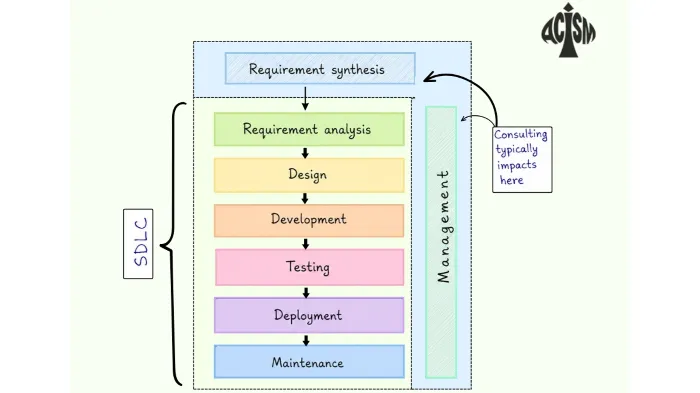
Impact areas of consulting and their relation with Software Development Life Cycle.
Impact areas of consulting and their relation with Software Development Life Cycle.
Many enterprise software initiatives fail long before a single line of code is written. The root causes are rarely programming mistakes. Instead, businesses often struggle with unclear requirements, poor technology decisions, unrealistic budgets, and a lack of alignment between stakeholders. This is why many organizations engage software consulting firms before beginning development.
Working with experienced software consulting firms helps businesses validate ideas, reduce uncertainty, and create a practical roadmap before investing in development. Rather than rushing into coding, consulting focuses on understanding business objectives, identifying technical challenges, and designing solutions that support long-term growth.
At Acism, software consulting goes beyond documentation. Our engineering-led approach combines business analysis, solution architecture, X-SDLC methodology, and Xsemble visual modeling to ensure every enterprise software project starts with clarity and confidence.
Enterprise software is expected to automate operations, improve productivity, integrate multiple business functions, and support future growth. Achieving these outcomes requires careful planning before development begins. This is where software consulting firms create significant value.
Consulting is the process of evaluating business needs, understanding workflows, identifying challenges, and defining a technology strategy before implementation. Instead of immediately discussing programming languages or frameworks, consultants first focus on business objectives and expected outcomes.
By engaging software consulting firms early, organizations gain better visibility into project requirements, technical feasibility, estimated costs, implementation timelines, and potential risks. This strategic foundation significantly improves the chances of successful software delivery.
Many organizations recognize the need for enterprise software but are unsure how to begin. Without proper consulting, several common challenges can delay projects or increase costs.
Business requirements are often incomplete because stakeholders have different expectations. Departments may define success differently, resulting in conflicting priorities that later affect development.
Technology selection is another challenge. Modern software ecosystems include cloud platforms, AI capabilities, mobile technologies, APIs, and enterprise integrations. Choosing the wrong technology stack can limit scalability and increase maintenance costs.
Budget estimation also becomes difficult when requirements are unclear. Without proper planning, project costs frequently increase due to unexpected features and changing priorities.
Project scope often expands during development because businesses discover missing requirements too late. Experienced software consulting firms help identify these gaps before coding begins, reducing costly revisions later.
Enterprise software failures rarely happen because developers lack technical skills. Most failures originate during planning.
Poor requirement gathering results in software that does not solve actual business problems. Communication gaps between business teams and technical teams create misunderstandings that continue throughout development.
Another major reason is the absence of technical validation. Organizations sometimes approve ambitious ideas without verifying whether they are technically practical or financially viable.
Weak governance also contributes to failure. Without structured planning, decision-making becomes inconsistent, priorities change frequently, and project visibility decreases. Professional software consulting firms help establish governance frameworks that improve accountability and project control from the beginning.
Successful custom enterprise software development begins with understanding how a business operates rather than simply identifying desired features.
Consulting starts with analyzing business processes, identifying operational bottlenecks, and evaluating existing systems. Consultants then determine how technology can improve efficiency while supporting future expansion.
An important part of planning includes conducting a software development proof of concept. This allows businesses to validate technical assumptions, evaluate integrations, and assess feasibility before making major investments.
Consultants also assist in preparing a comprehensive software development RFP or request for proposal software development document. A well-structured RFP clearly defines project objectives, business requirements, technical expectations, implementation scope, timelines, evaluation criteria, and vendor responsibilities. This ensures vendors submit accurate proposals and minimizes misunderstandings throughout the project lifecycle.
The primary objective of software consulting firms is reducing uncertainty before development begins.
Consultants perform detailed business analysis to understand organizational workflows and identify areas where software can create measurable value. They translate business needs into structured technical requirements that developers can implement accurately.
Solution architecture is another critical activity. Consultants recommend appropriate technologies, define system architecture, evaluate integration requirements, and ensure scalability for future business growth.
Requirement engineering helps prioritize features based on business impact rather than assumptions. This prevents unnecessary development while ensuring critical functionality receives proper attention.
Roadmap planning provides realistic implementation phases, milestones, resource allocation, and budget forecasting. Early identification of risks enables businesses to address potential issues before they affect delivery schedules or overall project success.
Unlike traditional consulting that focuses mainly on documentation, Acism follows an engineering-first consulting methodology.
Every engagement begins with discovery phase where business leaders, operational teams, and technical experts collaborate to understand objectives, challenges, and long-term expectations.
Our consultants conduct detailed business and technical requirement analysis while evaluating existing systems, workflows, integrations, compliance needs, and scalability requirements.
The next phase involves solution architecture planning, where our engineering team designs a practical technology roadmap aligned with business priorities.
Between the highly detailed Requirement Specifications and skimpy User Stories, Acism has created its own documentation standard that is further tweaked for individual case. Our collaborative approach enables stakeholders to validate requirements before development starts, reducing ambiguity and improving communication across teams.
Traditional requirement documents can be difficult for business stakeholders to interpret. Large documents often lead to misunderstandings because different teams visualize processes differently.
Acism addresses this challenge through Xsemble's X-Flowcharts.
These visual models illustrate exactly how business processes, user interactions, approvals, integrations, and software functionality will operate. Business users can easily review workflows, identify missing scenarios, and suggest improvements before development begins.
X-Flowcharts create a shared understanding between business teams, management, consultants, and developers. The result is improved requirement validation, better project visibility, reduced ambiguity, and significantly fewer changes during implementation.
The same X-flowcharts are later used during software development. They are used in code generation which ensures that the software application that gets created works exactly as per the pre-verified X-flowcharts. This visual engineering approach makes Acism different from conventional software consulting firms that rely primarily on written documentation.
Organizations that invest in consulting before development experience measurable advantages throughout the software lifecycle.
Projects begin with clearly defined business objectives, resulting in better requirement clarity and fewer development changes. Risk is reduced because technical feasibility and architectural decisions are validated early.
Development teams work more efficiently because requirements are complete and stakeholders share the same understanding of project goals. Better planning also reduces maintenance costs since scalable architecture and clean engineering practices are established from the beginning.
Most importantly, businesses gain confidence knowing their software strategy is built on validated engineering principles rather than assumptions.
Businesses choose Acism because our consulting combines strategic thinking with practical engineering expertise. Rather than delivering generic recommendations, we create actionable implementation plans supported by X-SDLC methodology and Xsemble visual modeling.
Our engineering-first approach ensures every recommendation is technically achievable, scalable, and aligned with business objectives. From initial discovery through architecture planning, development, deployment, and long-term support, Acism provides complete enterprise software delivery under one roof.
Whether organizations require digital transformation, modernization of legacy systems, or new enterprise platforms, our consulting services help reduce project risk while improving collaboration, visibility, and delivery outcomes.
Successful enterprise software projects do not begin with coding. They begin with careful planning, business analysis, technical validation, and strategic decision-making. This is why organizations increasingly partner with experienced software consulting firms before investing in enterprise software initiatives.
At Acism, our engineering-led consulting approach combines business expertise, X-SDLC methodology, and X-flowchart visual modeling to help businesses reduce uncertainty, validate requirements, and build scalable software with confidence. By focusing on engineering excellence before development starts, we enable organizations to accelerate delivery, improve collaboration, and achieve better long-term business results.
Starting your software project with expert consulting can save significant time, cost, and effort throughout the development lifecycle. Acism helps businesses transform ideas into scalable enterprise solutions through engineering-led consulting, solution architecture, business analysis, and visual requirement modeling aided by X-flowcharts .
1. What do software consulting firms do before enterprise software development starts?
Software consulting firms analyze business processes, gather requirements, evaluate technology options, identify project risks, and create a strategic roadmap before development begins. By working with experienced software consulting firms, businesses can build enterprise solutions that align with their goals while reducing costly implementation mistakes.
2. Why should businesses hire software consulting firms before starting a project?
Businesses hire software consulting firms to gain clear project requirements, realistic budget estimates, technology recommendations, and implementation strategies before development begins. Experienced software consulting firms help reduce project risks, prevent scope creep, and improve collaboration between business stakeholders and development teams.
3. How do software consulting firms support custom enterprise software development?
Software consulting firms play an important role in custom enterprise software development by validating business requirements, assessing technical feasibility, designing scalable solution architectures, and ensuring the software addresses real business challenges before coding starts.
4. How do software consulting firms use a software development proof of concept?
Leading software consulting firms often recommend a software development proof of concept to validate technical feasibility before full-scale development. A proof of concept allows businesses to test key features, evaluate integrations, reduce technical uncertainty, and make informed investment decisions.
5. Can software consulting firms help prepare a software development RFP?
Yes. Software consulting firms assist businesses in creating a comprehensive software development RFP or request for proposal software development document. This includes defining project objectives, technical requirements, timelines, budgets, and vendor evaluation criteria, ensuring accurate proposals and smoother project execution.
6. Why choose Acism over other software consulting firms?
Acism stands apart from traditional software consulting firms through its engineering-led consulting approach powered by X-SDLC methodology and X-flowchart visual modeling. This enables businesses to achieve better requirement clarity, stronger stakeholder collaboration, reduced project risk, and a clear roadmap for successful enterprise software development.
Acism Software Private Limited
📞 +91 9730668830
📧 contact@acism.com
Get in touch today to discuss your enterprise software goals and discover how our consulting team can help you build the right solution from day one.