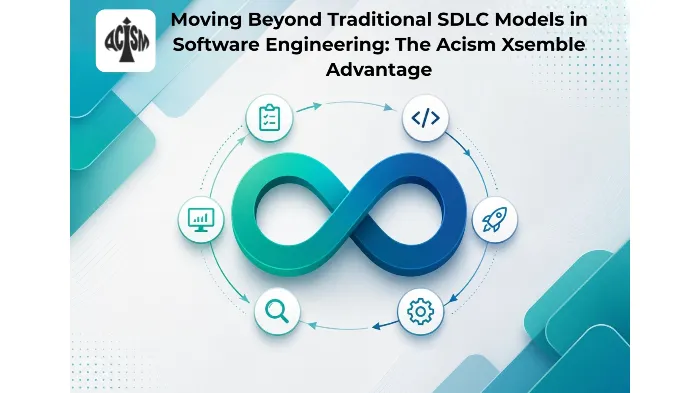
Acism's X-SDLC methodology, powered by Xsemble, enhances traditional SDLC models in software engineering through visual modeling, modular development, and improved collaboration for successful enterprise software projects.
Acism's X-SDLC methodology, powered by Xsemble, enhances traditional SDLC models in software engineering through visual modeling, modular development, and improved collaboration for successful enterprise software projects.
Building enterprise software is no longer just about writing clean code. Modern businesses expect software that is scalable, maintainable, and aligned with their operational goals. This is why SDLC models in software engineering have become the foundation of successful software development projects. These models provide a structured approach for planning, designing, developing, testing, deploying, and maintaining applications.
Although traditional methodologies such as the Waterfall Model, Agile, V-Model, Spiral, and Incremental Model have guided software teams for decades, many projects still suffer from missed requirements, communication gaps, and expensive rework. The challenge is not the process itself but the lack of visibility into how the software will function before development begins.
Acism Software Private Limited addresses this challenge through its innovative X-SDLC methodology powered by Xsemble. Instead of replacing traditional SDLC models in software engineering, X-SDLC enhances them with visual modeling that helps business stakeholders and development teams share a common understanding throughout the project lifecycle. The result is greater transparency, lower project risk, and software that is easier to maintain long after deployment.
Before choosing among different SDLC models in software engineering, it is important to understand what the Software Development Life Cycle actually means.
The Software Development Life Cycle (SDLC) is a systematic framework used to develop high-quality software through a series of well-defined phases. If someone asks what is software development life cycle SDLC, the answer is simple: it is a structured process that guides software projects from initial planning to long-term maintenance.
A typical model of SDLC includes requirement gathering, system design, development, testing, deployment, and maintenance. Following a structured SDLC in software development helps organizations improve collaboration, reduce development risks, control costs, and deliver reliable applications that meet business expectations.
There are several SDLC models in software engineering, each designed to suit different project requirements and business environments.
The software development life cycle waterfall model follows a linear sequence where each stage is completed before moving to the next. It works well for projects with clearly defined requirements but becomes difficult when changes are needed later in development.
The Agile Model focuses on continuous collaboration, short development cycles, and regular customer feedback. It is widely used for projects where requirements evolve frequently.
The V-Model extends the traditional Waterfall approach by pairing every development phase with a corresponding testing phase. This helps improve software quality and verification.
The Spiral Model combines iterative development with risk analysis, making it suitable for large and complex enterprise applications. Meanwhile, the Incremental Model delivers software in smaller functional releases, allowing businesses to start using key features while additional functionality is developed.
Although these SDLC models in software engineering offer different advantages, they all share one common limitation—they primarily focus on managing the development process rather than helping stakeholders visualize how the software will actually work.
Even organizations that carefully follow established SDLC models in software engineering often encounter project delays, budget overruns, and quality issues.
One of the biggest reasons is requirement misunderstanding. Business users describe what they need in business language, while developers interpret those requirements from a technical perspective. Small differences in understanding can lead to significant functionality issues later in the project.
Another challenge is limited visibility. Traditional documentation often explains what needs to be built but does not clearly demonstrate how the application will behave. As a result, stakeholders may not discover misunderstandings until development or testing is already underway, making corrections expensive and time-consuming.
Knowledge dependency is another concern. Many projects rely heavily on individual developers who understand the application's internal logic. When those developers leave the organization, maintaining or enhancing the software becomes much more difficult.
These challenges explain why even the most popular SDLC models in software engineering cannot always guarantee successful project outcomes.
Acism Software Private Limited has developed X-SDLC to overcome the limitations of traditional software development methodologies. Rather than replacing existing SDLC models in software engineering, X-SDLC strengthens them by introducing visual engineering throughout the software development lifecycle.
The methodology uses Xsemble technology to create standardized visual representations of application workflows before coding begins. This enables business stakeholders, analysts, developers, testers, and project managers to review and validate application logic together, ensuring everyone shares the same understanding before development starts.
By combining structured development practices with visual modeling, Acism significantly reduces ambiguity and improves project transparency.
X-SDLC methodology is about realizing the Software Development Life Cycle (SDLC) activities at a more granular level. By doing so, X-SDLC fosters the super-specialization of resources, enabling teams to contribute based on their core strengths while improving resource utilization throughout the software development lifecycle.
Xsemble makes this approach possible by decomposing an application into very small "molecular" components that can be developed, tested, and maintained independently.
This granular decomposition aligns perfectly with the goals of X-SDLC, making Xsemble-based development a core part of the methodology. It also reduces dependency on individual developers, simplifies future enhancements, improves long-term maintainability, and helps organizations build software that can evolve more efficiently as business requirements change.
Businesses require software that is reliable, scalable, and easy to maintain. Acism delivers these outcomes by combining proven engineering practices with innovative and more granular X-SDLC model.
Here are the tangible advantages that X-SDLC delivers:
Better Quality: With the right resources utilized for the right activity, their natural talent gets utilized. They not only make fewer mistakes but also sometimes over-deliver with fabulous results.
Robust Development Process: Project Managers have a better flexibility to choose from resources of similar skill. It is also easier to replace an outgoing resource with another one. This means that the development process can absorb the shocks of people leaving.
Speed of Development: X-SDLC identifies the inputs and outputs of each activity which gives a better way to run the activities in parallel. Especially in an Agile context, where X-SDLC is applied to small chunks of work that are scoped into multiple iterations, this parallelism works beautifully to shrink the overall time.
Acism helps organizations build software that is easier to understand, manage, and evolve as business needs change.
Traditional SDLC models in software engineering continue to play an essential role in managing software projects, but today's enterprise applications require more than structured processes alone. Successful software development depends on clear communication, complete visibility into the work progress, and a shared understanding between business stakeholders and technical teams.
Acism's X-SDLC methodology, powered by Xsemble visual modeling, enhances traditional development approaches by providing exactly that. Through visual intelligence, standardized workflows, and engineering excellence, Acism helps organizations reduce project risks, improve collaboration, simplify maintenance, and build enterprise software that delivers long-term business value.
If you're looking to move beyond conventional software development practices and deliver high-quality enterprise applications with greater confidence, Acism is ready to help.
Phone: +91 9730668830
Email: contact@acism.com
Get in touch with our experts to learn how X-SDLC and Xsemble can transform your next software development project.
1. What are SDLC models in software engineering?
SDLC models in software engineering are structured methodologies that guide software projects through planning, design, development, testing, deployment, and maintenance. They help teams improve quality, manage risks, and deliver software efficiently.
2. What is Software Development Life Cycle (SDLC)?
The Software Development Life Cycle (SDLC) is a systematic process used to develop software from initial requirements to long-term maintenance. It ensures projects follow a structured and organized development approach.
3. What is the software development life cycle waterfall model?
The software development life cycle waterfall model is a sequential development methodology where each phase is completed before the next begins. It is most suitable for projects with stable and well-defined requirements.
4. How is Acism's X-SDLC different from traditional SDLC models?
Acism's X-SDLC enhances traditional SDLC models in software engineering by making it more granular, incorporating the modular development feature of Xsemble into it.
5. Why do software projects fail despite using SDLC?
SDLC gives a broad outline of the logical flow, but the individual activities within each of the SDLC phases are left to interpretation. This subjectivity is the reason projects can fail despite using SDLC. The individual activities that need to be done are either not correctly understood or compromised.
The development phase of SDLC, where code is developed, acts like a catch-all pit for all shortcomings in the execution of other phases. Some times it is possible to recover, some times it is not. This is where projects start failing.
6. What benefits does Xsemble provide?
Xsemble provides a Design-first approach, where one cannot proceed to Development phase without adequate Design. The thinking and validation done in the Design phase greatly reduces the chances of Development getting out-of-hand.
Later, Xsemble uses the same Design as the basis of generating application code, ensuring 100% alignment of the application's working logic with the Design.
7. Why should businesses choose Acism?
Acism combines proven software engineering practices with innovative visual modeling through X-SDLC and Xsemble, helping businesses deliver reliable, maintainable, and future-ready enterprise software while reducing long-term project risks.