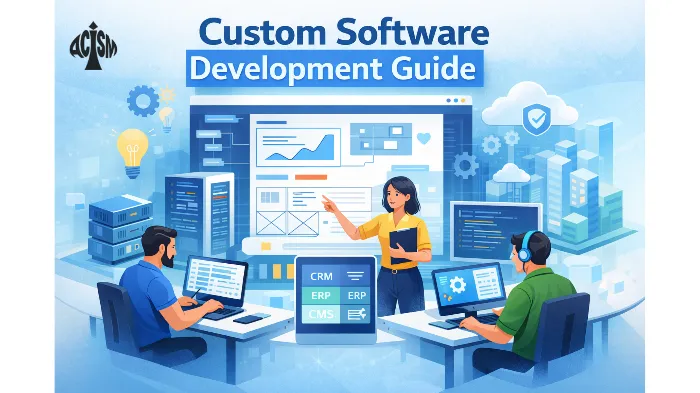
Step-by-step custom software development lifecycle for scalable business solutions
Step-by-step custom software development lifecycle for scalable business solutions
In today’s rapidly evolving digital landscape, businesses require software solutions that are tailored to their unique needs.. Off-the-shelf software may offer quick implementation, but it often fails to address specific workflows, scalability requirements, and integration needs. This is where a Custom Software Development Guide becomes essential for organizations that want to build software designed specifically for their operations.
A well-structured Custom Software Development Guide helps decision-makers understand the process of building software from scratch, the advantages it offers, and the key factors that influence successful implementation. Businesses that follow a clear custom development strategy are better positioned to improve efficiency, streamline operations, and create digital products that support long-term growth.
This Custom Software Development Guide explains the fundamentals of custom development, how the process works, and what businesses should consider before investing in tailored software solutions.
Custom Software Development refers to the process of designing, developing, deploying, and maintaining software that is specifically created for a particular organization or group of users. Unlike commercial software products that are built for a mass market, custom solutions are tailored to meet specific business requirements.
A comprehensive Custom Software Development Guide typically begins with understanding the problem a business is trying to solve. Companies often require systems that support unique workflows, integrate with existing infrastructure, and scale as the organization grows.
For example, a logistics company may need a platform to manage routes, shipments, and warehouse inventory simultaneously. While generic tools might offer some of these capabilities, a custom solution ensures that every feature is aligned with the organization’s operational processes. This is why many enterprises rely on a Custom Software Development Guide to make informed decisions about building software tailored to their needs.
One of the most important decisions businesses face is whether to choose custom software or ready-made applications. A reliable Custom Software Development Guide helps organizations understand the differences before making long-term technology investments.
Off-the-shelf applications are designed for a broad audience. They offer faster implementation and lower upfront costs, but they often include unnecessary features while lacking functionality that specific businesses actually need. As companies grow, these limitations can lead to inefficient workflows, integration challenges, and scalability problems.
Custom software development takes the opposite approach. Instead of forcing businesses to adapt their operations around software limitations, custom solutions are built around existing workflows and strategic goals. This allows organizations to improve operational efficiency while maintaining flexibility for future growth.
A detailed Custom Software Development Guide also highlights another key advantage of custom software: ownership and control. Businesses are not dependent on third-party vendors for updates, licensing structures, or feature availability. They can evolve the platform according to changing operational and market requirements.
For organizations with specialized workflows, compliance requirements, or long-term scalability needs, custom software often becomes the more sustainable and cost-effective solution.
Many organizations initially adopt ready-made software solutions because they are affordable and quick to implement. However, as companies grow, limitations begin to appear. Systems may not integrate properly with existing tools, workflows become inefficient, and customization options are often limited.
Following a structured Custom Software Development Guide allows businesses to overcome these limitations by building software that aligns with their exact requirements. Custom development offers greater flexibility, improved security, and better scalability compared to generic solutions.
Another advantage highlighted in any Custom Software Development Guide is long-term cost efficiency. Although the initial investment may be higher than purchasing commercial software, custom systems eliminate recurring licensing costs and reduce dependency on third-party vendors.
Furthermore, organizations gain full control over their software architecture, enabling them to adapt quickly as business requirements evolve.
A reliable Custom Software Development Guide emphasizes that successful software projects follow a structured development process. This process ensures that business goals are aligned with technical implementation.
The journey typically begins with a discovery phase where developers work closely with stakeholders to understand requirements, workflows, and business challenges. This stage is critical because it defines the foundation of the entire project.
The next phase involves system architecture and design. During this stage, engineers determine the technology stack, database structure, and system integrations required for the software. A clear design strategy ensures that the solution will remain scalable and maintainable over time.
Development then begins, where software engineers write code, build modules, and integrate features according to the project specifications. Throughout this stage, testing is continuously performed to ensure functionality, security, and performance.
A well-written Custom Software Development Guide also highlights the importance of quality assurance. Testing ensures that the final product performs reliably under real-world conditions and meets user expectations.
Once the system is ready, deployment takes place. After launch, ongoing maintenance and updates are necessary to ensure the software continues to function effectively as technologies and business requirements change.
Many software projects fail because businesses focus only on coding and delivery timelines without addressing long-term maintainability, scalability, and architectural clarity. Traditional development models often create systems that become difficult to enhance, expensive to maintain, and heavily dependent on individual developers.
This is where ACISM takes a different approach.
Many traditional development agencies prioritize rapid delivery, often creating systems that become difficult to maintain and scale over time. ACISM takes an engineering-first approach that focuses on architecture, maintainability, scalability, and long-term software reliability from the beginning of the development lifecycle.
One of the biggest challenges in Custom Software Development is project complexity. As applications grow, documentation gaps, unclear workflows, and inconsistent coding practices can create operational risks. ACISM addresses these issues through its proprietary X-SDLC methodology and visual engineering processes that improve transparency across the development lifecycle.
By focusing heavily on system architecture, modular design, and maintainability, ACISM helps organizations reduce technical debt while improving long-term software reliability.
Their engineering-driven approach also enables businesses to scale applications more efficiently as operational requirements evolve.
Another common issue in software projects is dependency on specific developers or teams. When knowledge is not properly documented, future upgrades and maintenance become difficult. ACISM’s structured development practices reduce this dependency by emphasizing visual workflows, documentation clarity, and process-driven engineering.
This approach is particularly valuable for businesses developing enterprise applications, AI-driven systems, ERP platforms, and other complex digital ecosystems that require long-term stability and scalability.
ACISM also emphasizes long-term software sustainability through structured support models and a 5-year bug-fix warranty approach designed to improve software reliability and operational continuity.
Before investing in custom development, businesses should evaluate several critical factors. A thoughtful Custom Software Development Guide encourages organizations to analyze their goals, budget, and long-term technology strategy.
First, it is important to clearly define the problem the software is expected to solve. Without clear objectives, projects may experience scope changes and delays. A well-defined roadmap helps developers focus on delivering features that provide real business value.
Another factor emphasized in a Custom Software Development Guide is scalability. Businesses should ensure that their software architecture supports future growth, increased data volume, and new features.
Security is also a major consideration. Custom applications often manage sensitive business data, making robust security measures essential. Secure coding practices, encryption, and regular audits should be incorporated during development.
Finally, selecting the right development partner plays a crucial role in project success. Experienced development teams bring technical expertise, industry knowledge, and proven methodologies that significantly improve the chances of delivering a successful software product.
As technology continues to advance, the demand for tailored digital solutions is increasing rapidly. Businesses are investing in cloud computing, artificial intelligence, data analytics, and automation tools to improve operational efficiency.
A forward-thinking Custom Software Development Guide recognizes that modern applications must be designed with flexibility and integration capabilities in mind. Organizations are no longer building isolated systems; they are creating interconnected digital ecosystems.
Custom development enables companies to integrate emerging technologies while maintaining control over their digital infrastructure. This adaptability ensures that businesses remain competitive in a constantly evolving technological environment.
Companies like ACISM are increasingly focusing on scalable engineering models that support modernization, enterprise transformation, and long-term software sustainability. As businesses adopt more advanced technologies, the need for structured and maintainable software architecture will continue to grow.
A well-planned Custom Software Development Guide provides organizations with a clear roadmap for building software tailored to their unique business needs. From understanding requirements to deploying scalable systems, custom development offers a powerful way to create technology solutions that drive long-term growth.
Businesses that invest in custom software gain greater flexibility, improved efficiency, and full control over their digital platforms. By following a structured Custom Software Development Guide, organizations can ensure that their software solutions remain reliable, scalable, and aligned with their strategic objectives.
Unlike conventional software vendors that focus primarily on rapid delivery, ACISM emphasizes engineering discipline, maintainability, scalability, and long-term software sustainability. This approach helps businesses build future-ready digital systems that support continuous growth, operational efficiency, and long-term reliability.
A custom software development guide explains the process of designing, building, deploying, and maintaining software tailored to specific business needs. It helps organizations understand development stages, benefits, and key considerations before investing in custom software solutions.
Businesses choose custom software development when off-the-shelf solutions cannot support their specific workflows or integration requirements. A structured custom software development guide helps companies create scalable applications that align with their operational processes and long-term goals.
Custom software development provides several advantages, including improved flexibility, better scalability, enhanced security, and seamless integration with existing systems. Following a custom software development guide ensures that the software meets business requirements and supports future growth.
The development timeline depends on the complexity of the project, required features, and system integrations. A well-planned custom software development guide outlines the stages of discovery, design, development, testing, and deployment to ensure efficient project execution.
Custom software development often requires a higher initial investment compared to off-the-shelf software. However, a well-planned custom software development guide shows that tailored solutions can reduce long-term costs by eliminating licensing fees and improving operational efficiency.
Every business has unique processes and operational needs. Following a reliable custom software development guide can help organizations design technology solutions that improve efficiency, scalability, and long-term performance.
Discover how ACISM helps businesses build custom software solutions tailored to their workflows and digital transformation goals.