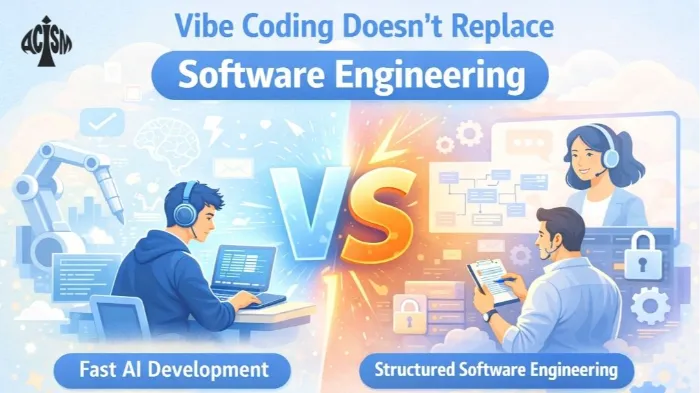
AI-powered vibe coding improves speed, but software engineering ensures control, scalability, and long-term system reliability.
AI-powered vibe coding improves speed, but software engineering ensures control, scalability, and long-term system reliability.
“Vibe coding feels magical… until the second rewrite. AI didn’t replace engineering. It exposed bad thinking.”
This statement captures the reality of modern development. AI tools are accelerating how we build software, making it easier than ever to generate code, test ideas, and launch products. However, this convenience has created a misconception that software engineering can be replaced by automation.
In reality, AI is reshaping custom enterprise software development, not replacing it. It is exposing weak thinking, poor architecture decisions, and over-reliance on shortcuts. Developers who depend entirely on AI without understanding the logic behind the code often face issues during scaling, debugging, and long-term maintenance.
Software development has evolved from low-level programming to highly abstracted systems where complex tasks can be executed with minimal code. Frameworks and libraries have enabled web application development companies and application development services providers to build faster than ever before.
However, abstraction comes at a cost. When a problem cannot be reduced to a simple function or library, it usually involves critical business logic that requires careful engineering. This is especially true in custom enterprise software development, where decisions directly impact system reliability, scalability, and security.
Relying too heavily on AI or external tools shifts control away from the developer. This becomes even more significant in software development outsourcing services or offshore software development outsourcing, where clarity, documentation, and ownership are essential. Unlike driving a car, where mistakes are immediate and visible, software errors can remain hidden and create long-term damage across systems and users.
The current AI wave is not the first time the industry has prioritized speed. Earlier, Rapid Application Development tools, no-code platforms, and low-code environments enabled teams to build MVPs quickly using mvp agile development practices. These approaches helped startups validate ideas and build initial versions of products such as a hospital application or a simple healthcare application.
However, as these applications scaled, limitations became evident. Systems built on shortcuts often struggled with flexibility, performance, and customization. Businesses requiring complex solutions such as customized ERP software or advanced banking software development services realized that speed alone was not enough.
This led to a growing demand for software modernization services and legacy software modernization services, where companies re-engineer their systems to regain control, improve performance, and ensure scalability. The lesson remains consistent: tools can accelerate development, but they cannot replace engineering depth.
AI has significantly enhanced development workflows. It can generate code, suggest best practices, assist with debugging, and even help create a software development proof of concept in a fraction of the time previously required. This has transformed how teams in saas software development company environments and crm software development projects operate.
Despite these advantages, AI introduces a critical challenge—responsibility. Every line of code carries implications for security, performance, and system integrity. In industries like fintech and healthcare, where fintech software development company and medical software development companies operate, even small errors can lead to serious consequences.
AI-generated code must always be reviewed, tested, and understood. Blind trust in automation can introduce vulnerabilities, inefficient logic, and architectural flaws that are difficult to detect early but costly to fix later.
Software development is not about quickly assembling features; it is about designing systems that are reliable, scalable, and maintainable over time. This requires structured thinking, a deep understanding of requirements, and careful planning throughout the development process.
In custom enterprise software development, teams must follow well-defined sdlc models in software engineering, including approaches like Agile and the software development life cycle waterfall model, depending on project needs. These frameworks ensure that development is systematic and aligned with business goals.
Additionally, aspects such as software development cost estimation, planning a software development rfp, and defining a clear request for proposal software development process are essential for successful project execution. This is where software consulting firms provide value by guiding organizations in making informed technical and strategic decisions.
AI should be viewed as an assistant rather than a replacement. It enhances productivity by automating repetitive tasks and providing quick solutions, but it cannot replace human judgment. Developers working in custom web app development companies or healthcare software development company environments can use AI to accelerate workflows, but they must still validate every output.
For example, AI can help teams estimate timelines, suggest architectural patterns, and reduce manual effort. However, the responsibility of ensuring correctness, security, and scalability always remains with the developer. This is particularly important in complex systems built by fintech software development companies, where compliance and reliability are non-negotiable.
Vibe coding is effective for quick experimentation and learning. It helps beginners understand how to make software and allows teams to rapidly prototype ideas. However, it falls short when applied to production-grade systems.
Enterprise applications, regulated platforms, and large-scale systems require deep engineering expertise. A custom healthcare software development company or a fintech software development company cannot rely on unverified AI-generated code. These systems demand precision, validation, and adherence to strict standards.
In such environments, shortcuts often lead to long-term issues, including technical debt, performance bottlenecks, and security vulnerabilities. This is why serious projects continue to rely on structured engineering practices rather than purely automated approaches.
As technology evolves, businesses must continuously adapt their systems. Many organizations face challenges with outdated architectures, which is why software modernization services and legacy software modernization services have become critical.
Modernization involves more than updating code. It requires rethinking architecture, improving scalability, and integrating modern technologies. AI can assist in this process, but it cannot replace the strategic decision-making required to transform legacy systems into future-ready solutions.
The future of software development lies in balancing speed with control. AI and automation provide incredible advantages, but they must be used responsibly. Developers must maintain ownership of their code, understand the systems they build, and ensure long-term quality.
This balance is essential for organizations offering application development services, engaging in software development outsourcing services, or building complex custom enterprise software development solutions. Speed without control leads to instability, while control without efficiency slows innovation. The key is to integrate both effectively.
The evolution of software development tools from RAD and low-code platforms to AI-powered assistants has made building software faster and more accessible. However, the core principle remains unchanged: increased abstraction reduces control.
AI and vibe coding are powerful tools, but they do not replace software engineering. They amplify productivity, but they also demand greater responsibility.
Ultimately, software development is not just about writing code. It is about engineering systems that are secure, scalable, and built to last. Whether working in a saas software development company, a healthcare software development company, or a fintech software development company, the responsibility always lies with the developer.
1. What is vibe coding and how does it impact software development?
Vibe coding refers to using AI tools to quickly generate and build software with minimal manual effort. While it improves speed, it often lacks deep understanding of business logic, which is critical in custom enterprise software development.
2. Can AI replace software engineers completely?
AI cannot fully replace software engineers because it lacks accountability, critical thinking, and architectural decision-making. Developers are still required to review, validate, and maintain systems, especially in complex domains like fintech and healthcare.
3. Why is control important in custom enterprise software development?
Control ensures that developers can manage security, scalability, and performance effectively. In custom enterprise software development, losing control can lead to long-term issues such as vulnerabilities, poor architecture, and high maintenance costs.
4. How do AI tools help in software development?
AI tools assist by generating code, debugging issues, and accelerating development workflows. They are widely used in application development services and saas software development company environments to improve efficiency while reducing manual effort.
5. When should businesses choose software modernization services?
Businesses should opt for software modernization services when their existing systems become outdated, slow, or difficult to scale. Modernization helps improve performance, security, and compatibility with new technologies while reducing technical debt.