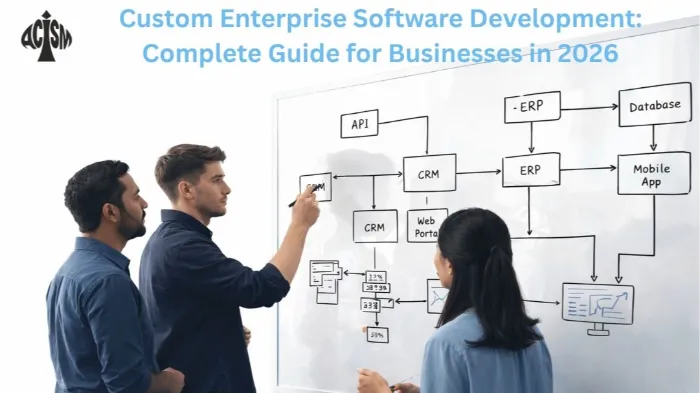
Acism's visual-model approach makes enterprise software architecture transparent to both developers and business stakeholders.
Acism's visual-model approach makes enterprise software architecture transparent to both developers and business stakeholders.
Table of Contents
Most businesses hit the same wall at some point. The CRM works, but not for your industry. The ERP handles procurement but not the way your team actually runs procurement. You spend years working around a tool that was never built for you.
That's exactly the problem custom enterprise software development solves. And in 2026, more organizations are treating it as core infrastructure investment rather than a one-off IT project. This guide covers what the process involves, what separates a well-run engagement from a failed one, and what to look for in a development partner.
Custom enterprise software development is the process of building software from scratch or from a modular base specifically to fit how your organization operates. No feature bloat from other industries. No premium tier needed to unlock workflows that are standard for you. The software is architected around your requirements, your data model, your team structure.
This is different from customizing an off-the-shelf product. When you customize Salesforce or SAP, you're working within their constraints, their data model, their update cycles, their pricing. Custom enterprise software development means the architecture itself answers to your business, not a vendor's product roadmap.
The categories where this matters most:
Off-the-shelf products are built for the average buyer. They make assumptions about team sizes, industry workflows, and data structures. For a small team, those assumptions are fine. For an enterprise with complex operations and a decade of operational specifics, the software either bends your processes to fit its logic or you spend years configuring your way out of the gap.
The hidden cost isn't the license fee. It's the workarounds: manual exports between systems that should talk to each other, shadow spreadsheets maintained by whoever understands the gap. These aren't IT problems they compound into business problems over time.
Custom enterprise software development closes that gap. A 100% match with business requirements is only achievable when the software is built for those requirements from the ground up. Anything less is a compromise that costs you somewhere.
The general stages hold across most engagements, but quality varies enormously in execution.
This is where most projects quietly start failing. Vague requirements produce software that doesn't match expectations and then disputes about what was agreed. Good custom enterprise software development starts with detailed, written requirement documentation that stakeholders sign off before any design begins. This becomes the reference point for everything that follows.
Before writing a line of code, the software's architecture should be visually mapped: control flow, data flow, component boundaries all visible to business stakeholders, not just developers. This lets domain experts validate the design while changes are cheap, not after six months of development. It also makes onboarding new developers faster when the original team isn't around.
The most reliable custom enterprise software development engagements use modular iterations – small, defined builds rather than one long project. Two practical benefits: you can test and validate features as they're delivered, and when business priorities shift mid-project (they will), the architecture absorbs the change without a full rebuild.
Software that works on delivery day but breaks down in six months isn't a success. QA in custom enterprise software development should cover functional testing, performance under load, and documentation thorough enough that any competent developer –not just the original team– can maintain and extend it.
The industry has a well-documented problem: software project success rates sit around 30%. That isn't a technology problem – it's a process and communication problem.
When evaluating a partner for custom enterprise software development, look for:
It's also worth asking whether the firm offers consulting beyond delivery. Projects that stall mid-execution, or that were poorly scoped from the start, need more than a development shop. They need a turnaround partner. See our upcoming guide on software consulting firms for more on this.
Acism has been doing custom enterprise software development out of Pune since 2001, working with clients across manufacturing, fintech, healthcare, and B2B SaaS. The core problem the methodology is built to solve: conventional development leaves too much invisible. Requirements live in email threads. Architecture lives in one developer's head. When that developer leaves, the project suffers.
For any custom enterprise software development engagement to work long-term, the internals need to be visible not just to the dev team. The X-SDLC model makes software internals visible at every stage components, data flow, control logic in a format domain experts can read and validate directly. This isn't cosmetic. It catches design problems before the coding stage, which directly cuts rework. It also supports incremental development: clients building for a new market can develop an initial feature set, pause the engagement, and restart later without paying a heavy re-orientation cost.
For teams already carrying a stuck custom enterprise software development project, Acism also handles turnarounds stepping into delivery problems that other firms couldn't resolve.
Explore the full scope of what's available on the Application Development Services page.
If your business has outgrown what packaged software can offer or you're in a domain where no off-the-shelf product does the job well, custom enterprise software development is the practical answer. The investment is real, but so is the compounding cost of workarounds, manual processes, and software that was never designed for your operations.
The question isn't really build vs. buy. It's whether the software you're running is actually moving the business forward, or just roughly keeping up.
Ready to discuss your project?
Explore Acism's Application Development Services to see how the engagement works — or contact the team directly at contact@acism.com to start a conversation.