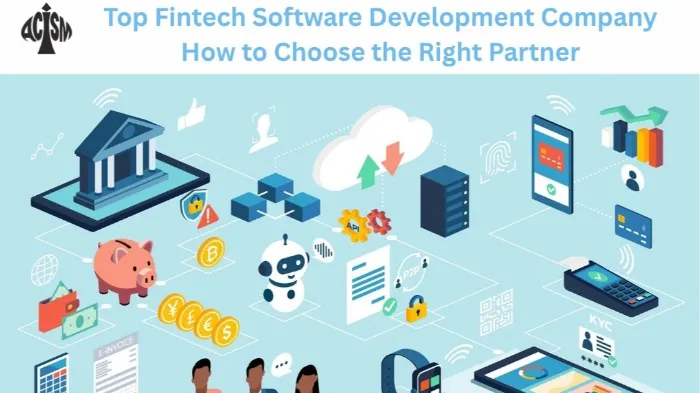
A practical guide to choosing the right fintech software development partner for secure and scalable solutions.
A practical guide to choosing the right fintech software development partner for secure and scalable solutions.
Choosing a fintech software development company is not the same decision as hiring a general IT vendor, and treating it like one is where most projects go wrong. Financial software handles customer money, regulatory audit trails, and compliance obligations that can be inspected at any point by regulators who have no patience for "we are still working on it." A compliance gap in a banking module is not a bug you patch in the next sprint. It is a regulatory event.
Yet most companies still evaluate a fintech software development company based on portfolio slides and a pricing spreadsheet. This guide covers the questions that actually matter.
A fintech software development company builds software for banks, lending platforms, payment gateways, insurance systems, and investment tools. That sounds like standard application development services. It is not. Financial software has to handle regulatory compliance across frameworks like RBI, SEBI, and PCI-DSS, real-time transaction processing, fraud detection, and multi-tier data security often in the same module, at the same time.
Most web application development companies can build a functional product. A fintech software development company needs to go further. The engineering has to account for how audit trails are structured, how financial instruments behave under edge conditions, and how legacy banking infrastructure communicates with modern API-driven systems. Almost every financial institution in India still runs critical operations on legacy systems, some unchanged for a decade. A fintech software development company with no experience in legacy software modernization services is only useful for greenfield projects.
Fintech companies typically work with third party compliance consultants. The fintech software development company needs to have a close interaction with these consultants, through the audits and to address any issues found in the audit.
What separates Acism from a general software house is how domain expertise and engineering interact. The business logic in financial software loan calculation rules, fraud detection triggers, multi-tier authorization is dense enough that a compliance officer needs to be able to read it, not just trust that the code is correct. Acism uses X-flowcharts to keep control flow and data flow visible throughout the project. Domain experts validate the logic without reading a line of code. In a regulated environment, that is the difference between continuous compliance review and a last-minute audit panic.
A bad fintech software development company rarely announces itself at contract signing. The warning signs come later six months or a year in when scope has grown, timelines have slipped, and a compliance gap surfaces during internal review or, worse, an external audit.
The first red flag usually appears during software development cost estimation. If a vendor can’t clearly explain their SDLC approach, how they account for legacy system integration, or where compliance reviews fit within their sprint cycles, they’re offering a quote not a well-thought-out analysis. Vague software development cost estimation reflects vague thinking, and in fintech, vague thinking produces change orders and compliance risk.
The same applies to a software development RFP response. A fintech software development company that cannot clearly explain its methodology, assumptions, and cost estimation within a proposal is presenting a number, not a plan and is unlikely to execute reliably once the contract is signed.
If you are evaluating offshore software development outsourcing options, the risks can compound quickly. Time zone gaps and unclear accountability structures can stretch a nine-month project into an eighteen-month engagement.
This does not mean offshore is the wrong choice. Acism operates as a reliable engineering partner, combining cost efficiency with strong process governance, clear accountability, and delivery discipline.
More importantly, beyond execution, Acism provides structured engagement models with defined quality checks, risk mitigation frameworks, and post-delivery support commitments ensuring continuity, stability, and long-term reliability.
The real question is not where the team is located, but how rigorously they manage delivery, ownership, and outcomes.
Can the company show you how the software works, not just an architecture diagram, but something that makes business logic visible flow by flow? This matters for compliance teams who need to validate rules before code is written, not after. A fintech software development company that keeps domain experts inside the process produces software with fewer compliance-critical bugs and cleaner audit documentation. Acism's X-flowchart model exists specifically for this. The flowcharts stay updated through the project lifecycle, which means they remain useful for audit reviews long after launch, regardless of team changes.
Many firms say they follow Agile SDLC models in software engineering and stop there. Agile is often incorrectly used as an excuse to drop right processes, and held responsible for the resulting poor quality. A fintech software development company ready for regulated work should explain how compliance review fits into the sprint cycle, how regulatory changes mid-project are handled, and how requirements are traced from business intent to deployed code. How a company runs its SDLC determines whether the software holds up in an audit.
A software development proof of concept (PoC) is one of the most effective ways to validate whether a technical approach aligns with your business and domain requirements. At Acism, we support structured, paid PoC engagements that ensure dedicated resources, clear deliverables, and meaningful outcomes.
Our experience shows that a well-defined PoC delivers real value only when it is approached with commitment from both sides. If you’re looking to evaluate our capabilities through a focused PoC, start with a conversation.
Banking software development services sit at the most complex end of the fintech spectrum. KYC compliance, transaction reconciliation, multi-tier authorization, and core banking integration all carry regulatory profiles that are different from a payments app or a trading dashboard. A fintech software development company handling banking-grade work needs direct, demonstrable experience with security and auditability, not a claim of general "financial domain expertise".
Banking software also needs to keep working correctly years after launch, through team changes, technology upgrades, and regulation revisions. That long-term orientation changes how a fintech software development company approaches architecture and documentation from the very first sprint. Acism's X-SDLC process is built around exactly this; the X-flowchart stays accurate and up to date through team changes and regulation revisions, not just at launch.
Finally, the Banking software needs to be updated from time to time, in response to compliance requirements or market changes. Thus, one needs to plan for not one but several development stages with gaps. These gaps can range from a few months to a few years. The software needs to be easy-to-upgrade after such gaps – possibly with changed team members. Acism’s approach proves to be most beneficial here, as the application logic captured in X-flowcharts stays within the project team even when its members change. It is therefore possible to take up new feature development at any stage.
MVP agile development is the right strategy for validating product-market fit before full investment, particularly for fintech startups entering lending, micro-savings, or embedded payments markets. In some other cases, MVP is done to get a technical proof of working.
The mistake is treating the MVP as a prototype with no production-grade constraints.
Some kinds of security, encryption, and compliance controls can be added later, but some others have to be in from day one. A fintech software development company that defers these to a future sprint is creating technical debt that will have to be carefully settled before the product can go live in a regulated context. The question is not whether to build an MVP, but whether your fintech software development company can correctly identify what is genuinely deferrable and what is not. Deferred features are fine. Deferred compliance is a different problem entirely.
See how Acism handles custom software development for early-stage and enterprise fintech projects. In most cases, MVP is not thrown away after proving what it is meant to prove, but it gets used in building the product. This in turn protects your investment.
Acism is a fintech software development company based in Pune, India. The X-flowchart model is the clearest expression of how Acism approaches financial software: domain experts see the logic, sign off on it before code is written, and stay in the loop through the entire project lifecycle. Compliance review is continuous, not a final-stage checkbox.
If an MVP needs to be built, Acism builds it quickly so that a go/ no-go decision can be made quickly. As said before, we further build the product upon the MVP once the decision is passed.
Acism brings the same engineering discipline to custom healthcare software development, custom enterprise software development, and legacy software modernization services making it a practical choice for enterprises that need software built to last, not just to ship.
If you are building financial software or modernizing a legacy system, start with a direct conversation about your requirements.